
Testosterone Treatment and Your Heart: Reassuring Findings from a Review of 31 Trials
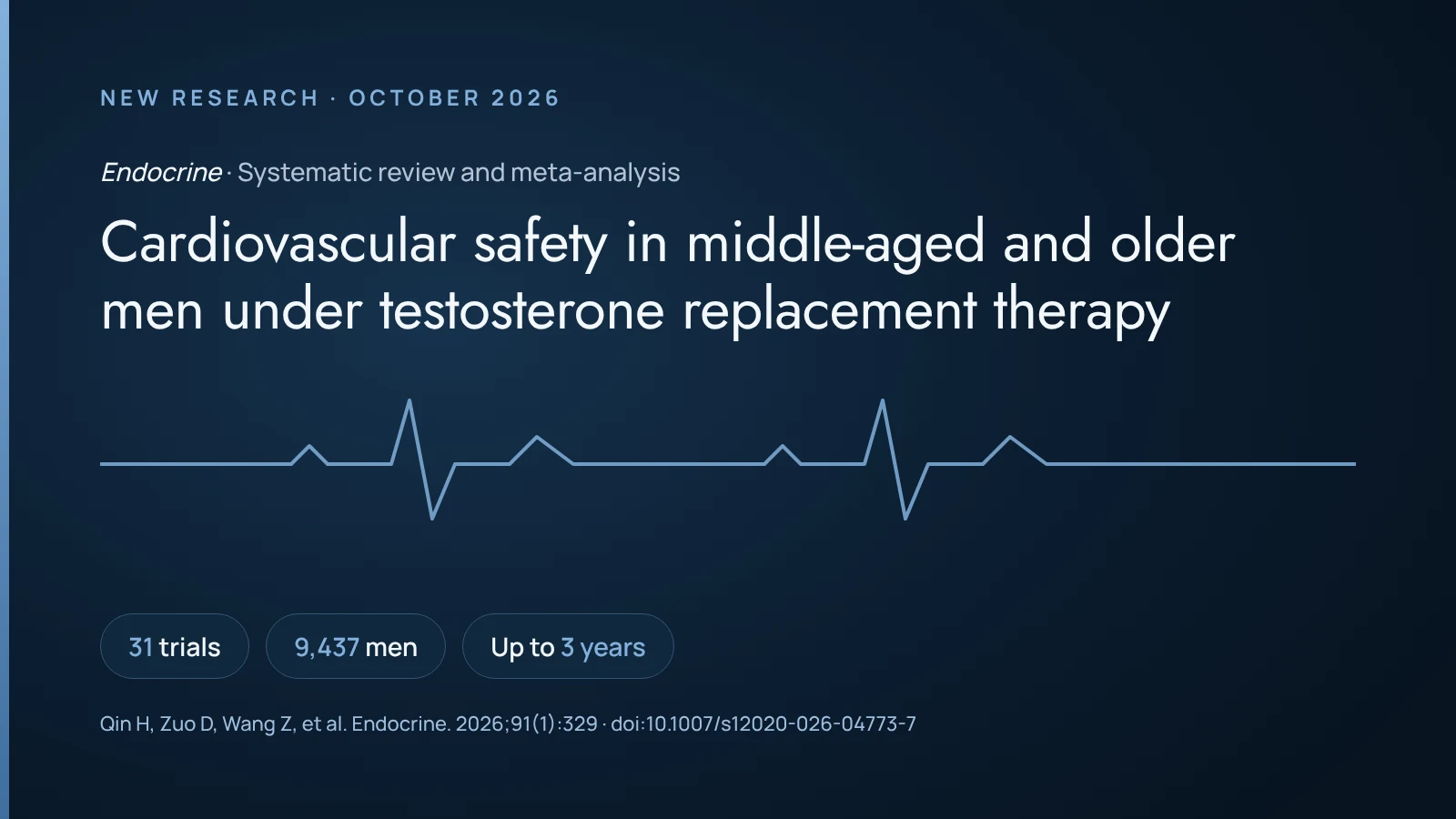
If you’ve ever looked into testosterone treatment, you may have heard it could be bad for your heart. It’s one of the most common worries men raise. A major new review, published in October 2026 in the medical journal Endocrine, brings together 31 clinical trials to answer that question. Its findings are largely reassuring.
The short version
- Researchers combined 31 trials involving 9,437 men, mostly middle-aged and older, with low or low-normal testosterone.
- Men on testosterone treatment had lower cholesterol, including “bad” LDL cholesterol, than men given a dummy treatment (placebo).
- They could also exercise for longer before their heart showed signs of strain, and the walls of a key neck artery were slightly thinner.
- The authors conclude that testosterone treatment appears to reduce overall cardiovascular risk factors.
- Heart rhythm problems were a little more common. This is something doctors keep an eye on as part of routine monitoring.
Why this question matters
Just over a decade ago, a handful of studies raised concerns that testosterone treatment might increase heart problems. Those concerns made many men, and some doctors, cautious. Since then, much larger and better-designed research has been carried out. This new review adds to a growing body of evidence that, for men who genuinely need it, testosterone treatment doesn’t appear to harm the heart.
What did the researchers do?
This was a systematic review and meta-analysis. Instead of running one new study, the researchers searched four large medical databases for every suitable trial published up to July 2024. Then they combined the results, so the conclusions carry more weight than any single study.
They only included randomised controlled trials, the gold standard for testing treatments. In these, men are put by chance into two groups: one gets testosterone and the other gets a placebo. That makes it a fair comparison.
Altogether there were 31 trials and 9,437 men. The trials lasted from about six weeks to three years.
What did they find?
Compared with the placebo groups, men on testosterone treatment had:
| What was measured | What it means | Result |
|---|---|---|
| Total cholesterol | The overall amount of fat-like substance in your blood | Lower |
| LDL (“bad”) cholesterol | The type that can build up in artery walls | Lower |
| Triglycerides | Another type of fat in the blood | Lower |
| HDL (“good”) cholesterol | The type that helps clear cholesterol away | No real change |
| Treadmill test | How long men could exercise before their heart tracing showed signs of strain | About a minute longer |
| Neck artery wall thickness | Thicker walls can be an early sign of hardening arteries | Slightly thinner after 1 to 3 years |
| Heart rhythm problems | The heart beating irregularly, too fast or too slow | A little more common |
On average, total cholesterol fell by about 0.26 mmol/L (10 mg/dL), the units your blood test report uses. Each of these changes is modest on its own. Taken together, they point in an encouraging direction, which is why the authors concluded that testosterone treatment appears to reduce overall cardiovascular risk factors.
What about heart attacks and strokes?
This review focused on heart risk factors, the measurements that help predict heart disease. The most important evidence on heart attacks and strokes comes from TRAVERSE, a large US trial published in 2023. It followed more than 5,000 men who already had, or were at higher risk of, heart disease. Testosterone treatment didn’t increase heart attacks or strokes compared with placebo.
One thing doctors keep an eye on: heart rhythm
In this review, heart rhythm problems were a little more common with testosterone treatment. TRAVERSE also found slightly more atrial fibrillation, a common type of irregular heartbeat. The researchers say the significance of this is still uncertain, and it’s a good example of why testosterone treatment should always come with proper medical oversight.
In practice, it simply means your doctor will ask about your heart health before you start. They’ll also want to hear about any palpitations, a racing or fluttering heartbeat, during treatment.
What this means for you
- The overall picture is reassuring. For men with confirmed low testosterone, current evidence doesn’t suggest treatment harms the heart, and several heart risk factors improved.
- Treatment is for confirmed deficiency. That means symptoms plus blood tests. Testosterone isn’t prescribed to prevent heart disease, and good heart health still comes from the basics: not smoking, staying active, eating well and managing blood pressure.
- Monitoring keeps it safe. Regular blood tests and reviews let your doctor check your response and pick up anything early.
- Always work with a doctor. Never start, stop or change testosterone on your own.
How we approach this at Northstar
Every assessment at Northstar starts with your history and blood tests, including a look at your wider heart health. If your first result shows low testosterone, we confirm it with a repeat early-morning sample before discussing any options. Treatment is only offered when it’s clinically appropriate, and it always comes with a monitoring plan.
If you’d like to talk through your symptoms, you can book an initial consultation.
The study: Qin H, Zuo D, Wang Z, et al. Cardiovascular safety in middle-aged and older men under testosterone replacement therapy: a systematic review and meta-analysis. Endocrine. 2026;91(1):329. doi:10.1007/s12020-026-04773-7. View on PubMed.